

By Editor Holly Wagner
Holly@observernews.net
The dragline claw tore into the earth, lifting another load of shells and sand from a quiet pit near Cockroach Bay.
To most people, it looked like an ordinary day at an ordinary mining operation. The Leisey Shell Corp. was digging material used primarily for roadbeds, just as it had done many times before.
But in the summer of 1983, something extraordinary emerged from the soil.
Scattered across the freshly turned ground were bones — not one or two, but hundreds of them. There were fragments from ancient horses, camels and other animals that once walked across a Florida almost impossible to imagine today.
Fossil hunter Frank Garcia knew immediately that this was no ordinary discovery.
He had been searching the Leisey Shell Pit with other amateur paleontologists for years, studying spoil piles and quarry walls for traces of the past. But what the dragline uncovered that summer was different. The bones seemed to be everywhere.
Garcia followed them back to their source: a dark, thin layer of silt buried beneath the shell beds.
Inside that layer was a lost world.
What followed became one of the richest Ice Age fossil discoveries ever made and placed the small community of Ruskin in the international scientific spotlight.
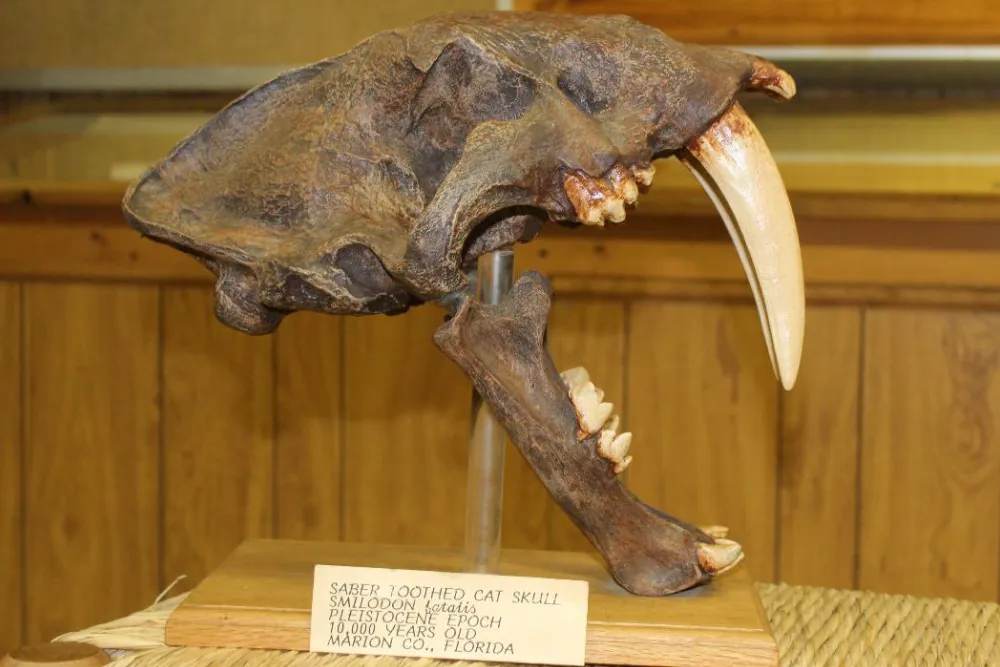
The site, later known as Leisey Shell Pit 1A, contained the remains of creatures that once flew above Florida, swam through its waters and moved across its ancient landscape. Mammoths, enormous ground sloths, prehistoric horses, camels, llamas, giant tapirs, peccaries, saber-toothed cats and short-faced bears were among the animals represented.
There were sharks, rays, fish, turtles, snakes, alligators and birds. Scientists even identified the partial skeleton of a previously unknown species of giant condor, a powerful bird related to the modern California condor. It is believed to have had a wingspan of about 15 feet.
Imagine standing beneath the shadow of a bird whose outstretched wings could nearly span the length of a family car.
The discoveries kept coming.
A mammoth jaw emerged from the earth. Then saber-cat teeth. Bones belonging to ancient llamas and camels appeared in remarkable numbers. Researchers found the remains of giant armadillo-like animals and ground sloths equipped with massive claws.
Each fossil was another clue. Together, they began telling the story of a Florida that existed long before highways, subdivisions and waterfront communities covered the landscape.
Scientists believe the area was once a protected coastal bay or estuary influenced by both salt water and fresh water. Mangroves and palms may have grown nearby. Rivers carried animals and plant material into the area, while calm water and fine silt helped preserve their remains.
The fossil-bearing layer was surprisingly thin — in some places only a few inches thick — yet it extended across an area of roughly half an acre. Packed inside was one of the most diverse collections of Ice Age animals ever uncovered in North America.
But the fossils were in danger.
The same machinery that exposed the bone bed could also destroy it. Mining was the purpose of the pit, and every passing day mattered.
Garcia and other fossil hunters reached out for help. The owners and managers of the Leisey Shell Corp. recognized the importance of what had been found and agreed to halt mining in the area.
For approximately 15 months, the company held back its equipment, giving researchers and volunteers time to recover the fossils. The owners also provided heavy machinery to remove layers of material covering the bone bed.
It was an extraordinary act of cooperation.
In January 1984, Garcia and paleontologist S. David Webb met with company representatives to plan a major excavation. Work began April 1 as a partnership involving the Florida Museum of Natural History, the Tampa Bay Mineral and Science Club, the Leisey Shell Corp. and members of the surrounding community.
Then Ruskin showed what a community could accomplish.
Hundreds of volunteers came to help. Some were trained scientists. Others were fossil enthusiasts, students or local residents who simply understood that history was waiting beneath their feet.
They worked under Florida’s unforgiving sun, carefully removing dirt from fragile bones. They searched through mud, recorded discoveries and carried specimens from the pit. The work continued into September, pausing briefly during the hottest part of the summer.
Every scrape of a tool carried the possibility of another discovery.
Would the next patch of soil reveal a tooth, a claw or an animal never before known to science?
By the time the excavation ended, more than 20,000 identifiable fossils had been recovered. The site represented 203 types of animals, including sharks, rays, bony fish, amphibians, reptiles, birds and mammals. More than 20 kinds of animals found there were new to science.
Among the most dramatic discoveries was a slender saber-toothed cat known as Smilodon gracilis. Unlike the larger saber-toothed cats many people recognize from museum displays, this species had a lighter build but still possessed the long canine teeth that made its family famous.
The site also produced evidence of two kinds of ground sloths, ancient horses and an early mammoth. Fossils from a giant tapir revealed that animals far larger than today’s tapirs once roamed the region.
The mixture of land, freshwater and marine animals made the discovery especially valuable. It was not merely a collection of large and impressive bones. Tiny fossils from fish, rodents, birds, reptiles and other creatures helped scientists reconstruct an entire ecosystem.
That is what made Leisey so remarkable.
The fossils did not tell the story of only one animal. They opened a window into a whole community of life.
News of the discovery spread far beyond Hillsborough County. Reporters came. Scientists took notice. Ruskin and the Leisey Shell Pit became known around the world.
Yet the heart of the story remained local.
It was the story of a self-taught fossil hunter who recognized that something important was rising from the dirt. It was the story of a company willing to stop its work so the past could be saved. It was the story of scientists and everyday residents kneeling side by side, united by curiosity and wonder.
The excitement surrounding the discovery also helped inspire the formation of the Tampa Bay Fossil Club, carrying that passion for paleontology into future generations.
Today, the original excavation area has become a pond. The draglines are silent, and the crowds of volunteers are gone. Someone passing the site might never guess what was once uncovered there.
But the story has not disappeared.
A historical marker on Mammoth Trail near Cockroach Bay commemorates what became known as the “Miracle at Cockroach Bay.” Fossils and information connected to the discovery also can be seen at the Paleo Preserve Fossil Museum at Camp Bayou Outdoor Learning Center at 4140 24th Street SE, Ruskin.
There, visitors can stand close to reminders of the enormous animals that once called this area home. Children can see that history is not always locked inside a distant museum or hidden in some faraway desert.
Sometimes it rests beneath the roads we travel, the neighborhoods we know and the ground beneath our own hometown.
And sometimes, all it takes is one watchful person to recognize a bone in the dirt, and a community willing to stop, kneel down and uncover the story together.