

By LOIS KINDLE
lekindle@aol.com
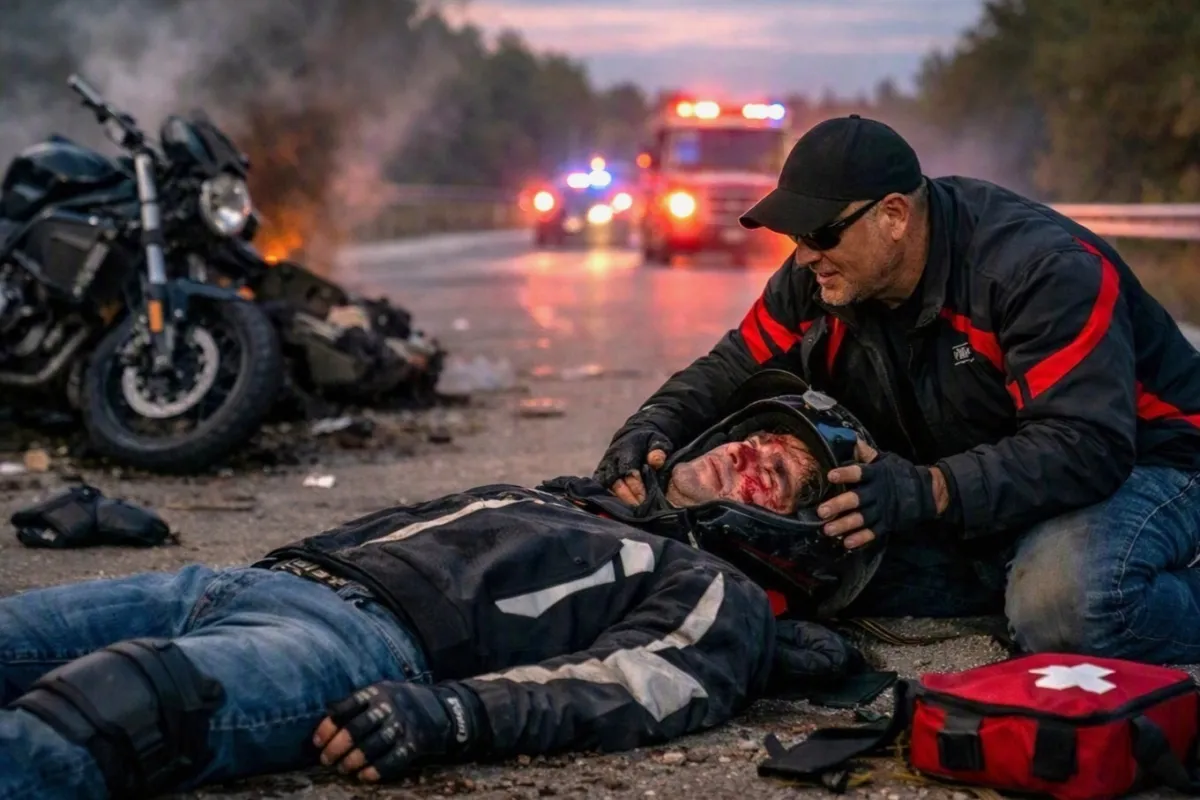
Regardless of where they happen, motorcycle crashes tend to have more serious consequences. While some riders walk away from the scene, that’s not usually the case. And depending on the location, a quick emergency response isn’t always available.
That’s why the Sun City Center Emergency Squad is offering Survive Until Help Arrives, a free class on basic first aid skills for motorcyclists, on Thursday, Oct. 22, at the squad’s Training Center, 124 Pebble Beach Blvd. S, Sun City Center. Participants can choose one of two class times, 9 to 11 a.m. or 6 to 8 p.m. After the first class, there will be a hands-on optional session on learning good compressions.
Each class can accommodate 20 people.
 “This is the first time the emergency squad has offered a class like this, and I hope that our local motorcycle riders will take advantage of it,” said Robin Watt, one of the squad’s longest-serving emergency medical technicians. “Being prepared and having some basic first-aid knowledge could make the difference between life and death when time is a critical factor.”
Watt has traveled all over the country and internationally on the back of her husband’s motorcycle, often in groups with other riders. She knows first-hand how critical it is to get help quickly.
One of the squad’s former volunteers, Chris Simko, sustained life-threatening injuries when he and his motorcycle were hit by a pickup truck on U.S. 301 and Balm Riverview Road, March 10, 2015. The driver fled the scene, and he was left in a coma.
Fortunately, EMS responders were close by.
“I would not be writing this, if it had not been for the rapid response of Hillsborough County Fire Rescue,” he wrote in response to a request for information. “The accident occurred at 11 p.m., after I had just completed a shift at the squad.
“I was told that Station 37 on Providence Road responded with an ALS unit due to the severity of my injuries,” he continued. “I was wearing a half-helmet. I suffered a severe head injury, midline jaw fracture, left orbital eye socket fracture and left lower leg dislocation.
Simko noted the lead paramedic who treated him said an unidentified man was working on him when they arrived. Due to the severity of his injuries, he was air-lifted to Tampa General Hospital. The neurologist who treated him said he had a GCS score of 2 on arrival and that she had never had anyone recover to the point he was in with the head injury he had sustained.
“I consider myself a walking testimony to the importance of the rapid response, training and the value of upgrading levels of response in a situation like this,” Simko said. “I was off work for seven months while rehabbing for all injuries. I have no lingering effects other than a few aches and pains. I was very fortunate to have a group of trained professionals treating me.”
To register for either Survive until Help Arrives class, scan the provided QR code or visit www.sccems.com and click on the events tab.
What the stats show
Studies from the American Ambulance Association show that more than 90% of Florida qualifies as an “ambulance desert,” defined as any location 25 minutes or more from an ambulance station. These areas are largely rural.
In 2025, Florida recorded more than 9,900 motorcycle crashes. Over 715 riders were killed, placing Florida among the top states nationally for motorcycle fatalities. Conditions linked to fatal versus non fatal crashes generally differ:
• Fatal crashes involve high speeds, alcohol involvement and nighttime riding.
• Non fatal crashes involve low speed impacts, heavy congestion and intersection conflicts.
Crash patterns also vary between urban/suburban and rural regions. Urban and suburban areas see more total accidents because of higher traffic volumes and frequent intersections. Rural areas report fewer crashes overall but a higher fatality rate per incident due to limited lighting, narrow shoulders and longer emergency response times.